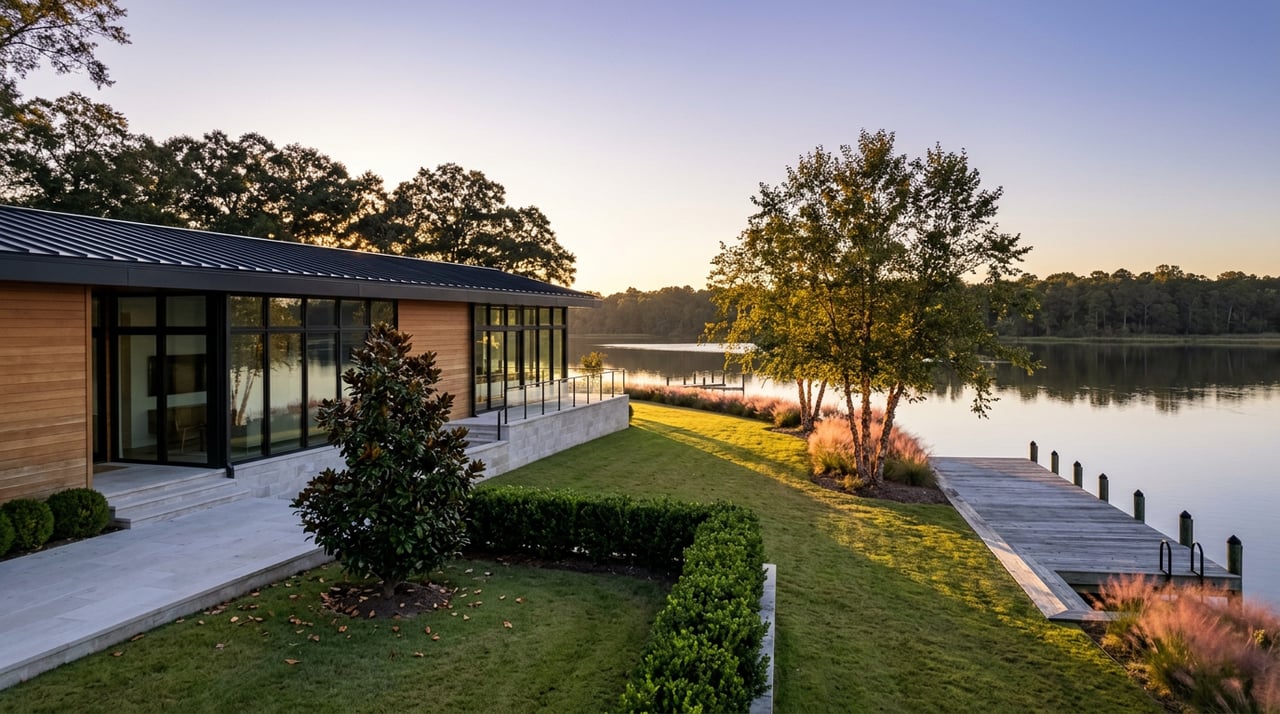
What if the one feature that justified the price of your waterfront lot is also the one thing you cannot confirm until after your house is already standing?
That is the situation facing anyone shopping for a vacant, buildable lot on Lake Norman in Mooresville right now. For years, a buyer eyeing a raw lot along the main channel or a quiet cove could get some read on dock feasibility before committing serious money to construction. Builders would open a conversation with Duke Energy's shoreline office early, during the feasibility phase, so the dock question got resolved in parallel with the build rather than after it. That informal safety valve closed on July 1, 2026.
What Duke Energy Actually Changed
Duke Energy, which owns and manages the lakebed and shoreline under a federal hydroelectric license, controls every dock permit on Lake Norman. The rule change is stated plainly on the utility's own permitting page:
Effective July 1, 2026, Duke Energy will no longer review private dock applications where no home is constructed on the adjoining lot. This requirement applies to all Duke Energy lakes.
The carve-out matters as much as the rule. This applies to private dock permits only. It does not touch shoreline stabilization requests, so a seawall or riprap application on a vacant lot still gets reviewed. But if what you want is a dock, and there is no home on the parcel yet, Duke will not even look at your application.
For a buyer whose entire reason for paying a waterfront premium is the ability to walk out the back door and step onto a boat, this is not a paperwork footnote. It is a change in the order of operations for the entire purchase.
The Sequence That Used to Work
Before this year, the smart move on a vacant Lake Norman lot was to get ahead of the dock question early. Some local custom builders made a habit of opening the Duke conversation during site planning and feasibility, before permits were pulled and before a single tree came down, specifically so the dock application would not sit unresolved and hold up dry-in once the house was framed.
That workaround is gone for any lot without a structure on it. The new sequence is: buy the lot, build the house, then apply for the dock. Duke's standard review window for a private dock runs roughly four to twelve weeks once an application is accepted, and that clock does not start until there is a home on the property to trigger eligibility.
Layer that onto the build timeline itself. Building permit reviews inside Mooresville's town limits are running five to nine weeks on a clean first submittal, with unincorporated Iredell County parcels running four to eight weeks. A typical custom home in the area takes twelve to fifteen months of active construction once permits issue, and waterfront projects with dock work or shoreline stabilization routinely add two to four months on top of that because those pieces run on a separate, parallel track from the building permit. Put the two timelines together and a buyer can be a year or more into a project, with a finished or nearly finished house, before Duke tells them what dock they are actually allowed to have.
That is a meaningful amount of capital to have deployed on an assumption. The median price for a waterfront home on Lake Norman was $2.36 million in the first quarter of 2026. Buyers building at that level are not treating the dock as a nice-to-have. It is a load-bearing part of the purchase.
Why This Is Worse Than It Sounds
The reason this rule change lands harder on Lake Norman than it might on a natural lake is that dock approvals here are genuinely lot-specific. Two neighboring parcels on the same cove can get different outcomes from Duke depending on the shoreline classification assigned to each one, the width of the cove, how far the dock would need to extend to reach usable water depth, and whether nearby docks already constrain navigation clearance. A dock on the property next door is not proof of what you are allowed to build. It is not even a reliable hint.
Add the shoreline buffer itself. Waterfront lots on Lake Norman carry a fifty-foot setback buffer split into two zones: an undisturbed, forested first thirty feet closest to the water, and a second twenty feet of managed vegetation further back. Activity in either zone, including a dock approach or a cleared sightline, typically needs its own authorization layered on top of the dock permit itself.
None of that has changed. What has changed is that a buyer used to be able to ask Duke, in advance, how those variables applied to a specific vacant parcel. Now, on a lot with no house yet, that answer is simply unavailable until the house exists.
What Kind of Lot You're Actually Buying
Not every Lake Norman lot carries the same exposure under the new rule. The practical difference comes down to whether a dock already exists and is properly permitted.
| Lot type | What the rule means for you |
|---|---|
| Vacant lot, no dock, no prior Duke history | Dock feasibility is now unknowable until the home is built and a new application is submitted. You are building on faith about your own waterfront access. |
| Vacant lot with an existing, permitted dock already in place | The rule does not apply to you the same way. An existing structure with a valid permit is not a new application. Your job is verifying the permit is transferable and in good standing, not waiting on new review. |
| Vacant lot with a dock that was removed or has lapsed permitting history | This sits in a gray zone. You will likely need to treat it like a brand-new application once the home is built, even though a dock existed there before. |
That middle row is where a lot's marketing language starts to matter more than it used to. A listing that notes a prior dock permit approved by Duke Energy, or an existing pier already in place, is not just describing a lifestyle amenity anymore. It is describing the only category of Lake Norman building lot where dock certainty is still available before you commit to construction.
What to Do Differently If You're Buying Land in Mooresville
If you are shopping for a buildable lot on the lake right now, particularly in the active new-construction corridors along Mooresville's southern shore and 28117, a few adjustments to the usual due diligence checklist are worth making before you write an offer.
- Ask directly whether the lot has an existing dock and, if so, whether the permit is currently in the seller's name or still needs a transfer. A permit that has never been transferred adds its own delay.
- If the lot is truly raw, do not treat the absence of a dock permit as neutral. Ask your agent or builder to pull whatever shoreline classification information is available for that specific parcel, not the general cove.
- Build contract language around the uncertainty rather than around an assumption. A purchase agreement or a builder contract that treats the dock as guaranteed, when Duke has not reviewed anything yet, is optimism dressed up as a plan.
- Sequence your builder conversations early. If Duke's review only starts once the house exists, the smartest move is minimizing every other delay in the build so the dock application clock starts as soon as legally possible.
- Separate your excitement about the view from your certainty about the water access. They are not the same purchase anymore.
What This Means If You're Selling a Lot Instead
If you own a vacant Lake Norman parcel in Mooresville with a dock already permitted and standing, this rule change is a reason to say so clearly and early in your listing, not bury it in the photo gallery. That existing permit is now doing work it was not doing a year ago. It is the difference between a buyer who can verify their waterfront access before closing and one who is taking it on faith.
A Few Questions Buyers Are Asking
Does this affect homes that already have a house and an existing dock? No. The rule targets new private dock applications on lots where no home has been built. An existing home with an existing, properly permitted dock is a different situation, though permit transfer at sale still needs to be handled correctly.
Can I still buy a raw lot and just wait to apply for the dock? Yes, but you are now waiting until after the house exists, which means the financial commitment to the home comes before the answer on the dock, not after.
Does a neighbor's dock tell me anything about what I could build? Not reliably. Duke evaluates each shoreline segment on its own classification, cove width, and navigation clearance, so a neighboring dock is not a guarantee for your parcel.
Lake Norman rewards buyers who understand its rules before they fall in love with a lot. This one is worth knowing before you sign anything. If you are weighing a vacant parcel in Mooresville and want a clear read on what you are actually buying, The Temple Team can walk the shoreline history with you before you commit. Schedule Your White-Glove Consultation.
This article is general information, not legal, tax or financial advice. Consult a qualified professional about your situation.